
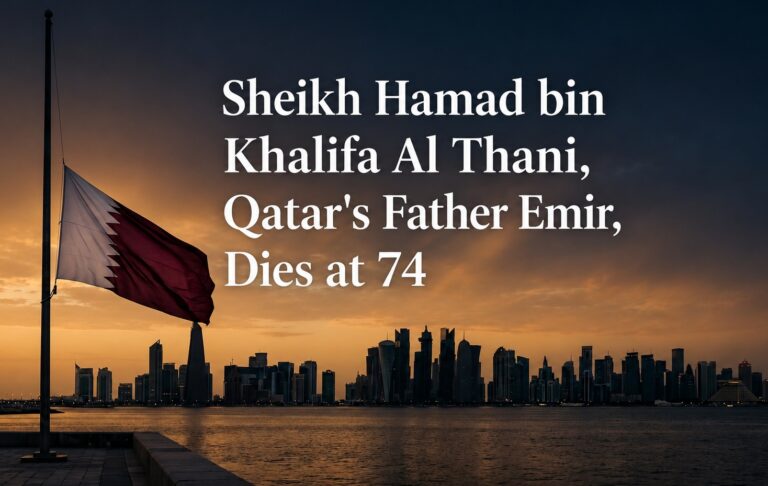
His Highness Sheikh Hamad bin Khalifa Al Thani, the Father Emir who spent nearly two decades reshaping the small Gulf nation into a global powerhouse, passed away in Doha on Sunday, July 12, 2026. He was 74.
The Amiri Diwan confirmed his death in a statement, and the government has declared four days of national mourning, with flags lowered to half-mast and work suspended across ministries and public institutions. His funeral prayer was held at sunset on the day of his passing at the Imam Muhammad ibn Abd al-Wahhab Mosque in Doha, where his son and successor, Emir Sheikh Tamim bin Hamad Al Thani, helped carry his body from the mosque alongside close family members.
Who Was Sheikh Hamad bin Khalifa Al Thani?
Born in Doha in January 1952, Sheikh Hamad trained at Britain’s Royal Military Academy Sandhurst before rising through Qatar’s military ranks. He became heir apparent and defense minister in 1977, and in 1995 he assumed power in a bloodless palace transition, taking over from his father, Sheikh Khalifa bin Hamad Al Thani.
What followed was one of the most dramatic national transformations in modern Gulf history. Over his 18-year rule, Sheikh Hamad turned Qatar’s natural gas reserves — among the largest in the world — into the foundation of an economic boom that made the country the wealthiest per capita on Earth, with average incomes reaching roughly $86,000 a year. Liquefied natural gas production surged to 77 million tonnes annually, positioning Qatar as a dominant global LNG exporter.
Building Modern Qatar
Sheikh Hamad’s legacy extends well beyond energy wealth. Under his leadership, Qatar:
He also positioned Qatar as an indispensable diplomatic mediator, involving the country in efforts to ease conflicts in Sudan’s Darfur region, Lebanon, and between Palestinian factions Hamas and Fatah. Support for the Palestinian cause remained central to his foreign policy throughout his life, and he became the first head of state to visit Gaza in more than a decade during one of his final official trips abroad.
A Rare Voluntary Handover
In June 2013, Sheikh Hamad did something almost unheard of among hereditary Gulf rulers: he voluntarily stepped aside. He handed power to his then-33-year-old son, Sheikh Tamim bin Hamad Al Thani, in a televised address, ushering in a peaceful generational transition rather than the succession disputes that have marked ruling families elsewhere in the region. He continued to hold the honorary title of Father Emir until his death.
Tributes From Around the World
News of Sheikh Hamad’s death drew swift condolences from regional and global leaders. Egyptian President Abdel Fattah el-Sisi mourned the loss to “the sisterly State of Qatar,” while UAE President Sheikh Mohamed bin Zayed Al Nahyan offered his sympathies directly to Emir Tamim. Leaders from across the Gulf, along with figures such as Indian Prime Minister Narendra Modi, who met Sheikh Hamad during a 2024 visit to Qatar, also paid tribute. The Palestinian group Hamas described him as a visionary leader who upheld genuine humanitarian and Arab principles throughout his life.
Qatari academics and commentators echoed a common theme in the hours after his death: that Sheikh Hamad did not simply grow Qatar’s economy, but redefined its place on the world stage. Analysts have pointed to his soft-power strategy — pairing gas wealth with media influence, sports diplomacy, and international mediation — as the blueprint that continues to shape Qatar’s foreign policy under Emir Tamim today.
His Legacy Going Forward
Sheikh Hamad leaves behind a Qatar unrecognizable from the one he inherited in 1995: a nation with an outsized global media presence, a top-tier sovereign wealth fund, a World Cup legacy, and a reputation as one of the Middle East’s most active diplomatic brokers. As the country observes its period of mourning, attention turns to how Emir Tamim and the next generation of Qatari leadership will carry forward the foundations his father built.